Zendaya ….The Modern icon we need
In an era when celebrity is often measured by constant exposure, Zendaya has built her influence through something far more powerful: discernment. She appears when there is something worth communicating, chooses clothes that become part of the story, and protects the parts of her life that do not belong to the public.
That balance—between extraordinary visibility and genuine privacy—is what makes her a truly modern icon.
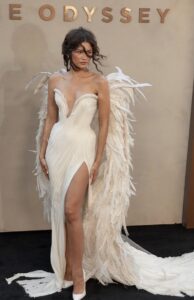
Fashion as intelligence, not decoration
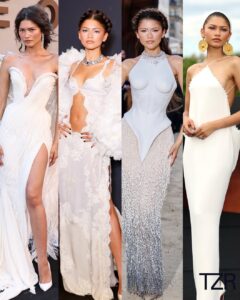
Zendaya’s talent for fashion goes far beyond simply looking beautiful in expensive clothes. Together with her longtime stylist and creative collaborator Law Roach, she has transformed the red carpet into a form of visual storytelling. Their celebrated approach to “method dressing” connects each outfit to the atmosphere, character or symbolism of the film she is promoting. What could have been a promotional obligation becomes an extension of the cinematic world.
But Law Roach’s contribution does not diminish Zendaya’s own instinct. A stylist can propose a dress, but the person wearing it must understand its language. Zendaya knows how to inhabit clothing. She understands posture, proportion, gesture and timing. She can wear an architectural couture creation without appearing overwhelmed by it, then appear days later in something restrained and seemingly effortless.
This is perhaps her greatest fashion gift: she does not merely wear a look; she completes it.
Her beauty operates in the same way. It rarely feels separated from her personality or transformed into a mask. Whether she appears with sculpted red-carpet glamour or embraces her natural hair and softer styling, she retains something recognisable and unforced. Her beauty does not ask us to believe in perfection. It communicates confidence, curiosity and an unusual freedom to transform without losing herself.


A grounded woman inside an extraordinary career
Zendaya represents a newer and healthier idea of fame. She can command the world’s most important carpets, work with major directors and fashion houses, and still appear grounded, warm and almost unaffected by the machinery surrounding her.
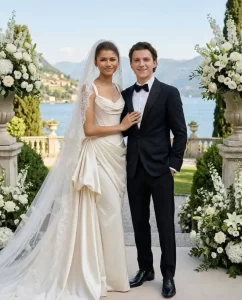
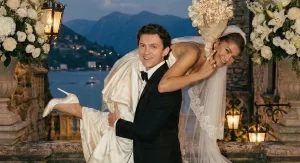
Her private wedding to Tom Holland expressed this perfectly. Rather than turning marriage into another publicity campaign, the couple succeeded in keeping the ceremony away from cameras and commercial spectacle. The marriage was disclosed only gradually, first through comments from Law Roach and later through Holland’s own references to Zendaya as his wife. Even after public confirmation, the couple maintained their boundary: the event belonged to them, not to an audience.
In a culture where celebrity weddings can become sponsored global productions, their choice felt almost radical. Privacy became the ultimate luxury—not secrecy created for publicity, but intimacy protected because it mattered.

Tom Holland and the appeal of the good boy next door
Tom Holland complements Zendaya’s image because he represents a similarly contemporary masculinity. He is internationally famous, yet retains the approachable quality of the good boy next door: humorous, affectionate, hardworking and apparently comfortable beside a woman whose presence can dominate any room.
Many people first remember him through Billy Elliot the Musical, where he performed in London’s West End while still a child. The story follows a boy who discovers ballet against the severe background of the 1984–85 miners’ strike in County Durham, in northern England—not Ireland. Holland was not himself the impoverished son of a coal miner, but his early performance connected him forever with that image: a young boy dancing with determination while an entire working-class community struggled around him. He was discovered through dance and spent years training before taking on the title role.
That history still contributes to his appeal. Before the superhero body and Hollywood fame, there was discipline, movement and vulnerability. His masculinity was never built only around physical power; it also emerged through dance, emotional expression and perseverance.
Together, Zendaya and Holland offer a version of the celebrity couple that feels remarkably free of theatrical dominance. Neither appears to reduce their own identity to support the other. Their relationship suggests companionship rather than performance.
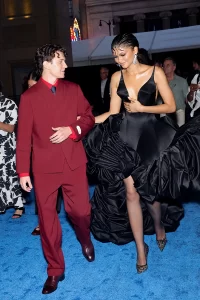
Spider-Man: Growing Up Together in Public
The recent promotional tour for Spider-Man: Brand New Day reveals another quality that makes Zendaya so compelling: she knows how to command attention without refusing to share it.
Zendaya and Tom Holland have grown up together through the Spider-Man films. What began in 2017 as the natural chemistry between two very young actors has gradually developed into a creative partnership, a private love story and, eventually, a marriage. During the promotion of the new film, they no longer appeared simply as Peter Parker and MJ, or even as a celebrity couple carefully presented for the cameras. They seemed like two people who genuinely understand the pressures, responsibilities and occasional absurdities of each other’s lives.
Zendaya has described returning to the Spider-Man set as a kind of homecoming: an opportunity to work beside her best friend and the person she loves, with even their dogs becoming part of the family atmosphere surrounding the production. That description is revealing. Their relationship does not appear to exist separately from their professional lives, but neither is it exploited as part of the film’s marketing. They support one another without turning every appearance into a public performance of romance.
During the international press tour, from Rome and Berlin to Paris, Mexico City, Los Angeles and London, their public chemistry remained affectionate but understated. There were shared smiles, private jokes, small gestures and carefully coordinated outfits, but never the sense that they were trying to manufacture a dramatic celebrity moment. At the London premiere on July 29, Holland’s face visibly brightened when Zendaya arrived to the cheers of the crowd. His reaction communicated pride rather than competition—the response of a husband who seems genuinely delighted by his wife’s brilliance.
This is particularly significant because Zendaya could easily dominate every event. Her fashion power, beauty and ability to create a memorable entrance are almost unmatched. Yet at the Spider-Man presentations she appears conscious that Holland is carrying the central character and the enormous responsibility attached to him. She does not make herself smaller, but she allows the spotlight to move naturally between them. It is a subtle form of emotional intelligence: knowing when to create the image and when to support the person standing beside you.
Their clothing also creates a visual conversation. At one appearance, Holland’s black Prada tailoring was enlivened by a Spider-Man-red shirt, while Zendaya’s black minidress was completed by shoes with red soles. Rather than wearing obvious matching outfits, they connected themselves through discreet details—dressing as individuals while still appearing unmistakably united.

Zendaya continued her method-dressing tradition throughout the tour, but with greater freedom and humour than before. In Paris, she transformed a vintage Spider-Man T-shirt—reportedly sourced for less than $35—into a playful minidress. In London, she wore a vintage 1997 John Galliano gown with a jewelled web across the back. For the Los Angeles premiere, she chose a sculptural Ashi Studio gown whose details suggested the anatomy of a spider without becoming a literal costume. These looks demonstrated that intelligent fashion is not determined only by price or exclusivity. A second-hand T-shirt can communicate an idea just as effectively as couture when it is chosen with imagination.
The Spider-Man tour therefore represents more than another sequence of successful red-carpet appearances. It shows Zendaya’s ability to combine fashion, storytelling, professional loyalty and personal affection. She can create a major visual moment while remaining part of a partnership. Beside her, Holland does not look threatened by her power; he appears proud of it. Beside him, Zendaya does not appear to be performing the role of the supportive wife; she looks like an equal who understands exactly when to shine and when to let someone she loves have his own moment.
Perhaps this is one reason audiences respond so warmly to them. Their story contains the fantasy of two young actors who met while making a superhero film and grew into adulthood together, but their behaviour remains surprisingly ordinary. They tease each other, support each other’s work, bring their dogs to the set and appear happiest in the small moments between the official photographs.
They represent a contemporary romantic ideal—not a prince and princess placed on a distant pedestal, but two talented people who seem to have remained friends while becoming global stars. Their Spider-Man appearances allow the public a glimpse of that bond, while never giving us the impression that we are entitled to see all of it.


One misstep on an otherwise brilliant journey
Even the most convincing modern icon should not be protected from criticism.
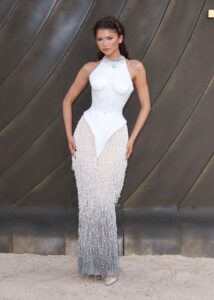
For the London premiere of Christopher Nolan’s The Odyssey, Zendaya wore a spectacular Schiaparelli Haute Couture gown designed by Daniel Roseberry. The dress featured a white porcelain-effect moulded bustier, mirrored fringe and an illuminated skirt—a technically extraordinary creation that matched the mythic scale of the film.
However, the gown had appeared on the runway in Paris and was then flown to London by private jet on the day of the premiere so Zendaya could wear it immediately. The story was presented as another dramatic fashion “odyssey,” but it also exposed one of the contradictions at the centre of contemporary luxury: environmental responsibility is celebrated in public discourse, while enormous resources may be consumed to secure a single red-carpet moment.
It would be unfair to attribute the entire decision personally to Zendaya. A premiere look involves a network of stylists, fashion houses, publicists, schedules and logistical teams. Yet an icon’s cultural influence also creates responsibility. The dress was magnificent, but bringing it from Paris to London on a private aircraft—between two cities connected by frequent trains—was an unnecessary excess.
It was not a fashion mistake. Visually, the choice was exceptional. It was a values mistake: a moment when the desire to produce an unforgettable image outweighed the more modern obligation to consider how that image was made possible.

The icon we need now
Zendaya’s significance lies precisely in the fact that she does not feel like an untouchable monument. She is talented, strategic and visually extraordinary, but she also appears human. She can make excellent choices and still occasionally participate in a questionable one.
A modern icon should not be someone who never makes a mistake. She should be someone capable of recognising the changing meaning of influence.
Zendaya represents elegance without coldness, ambition without desperation, beauty without obvious artificiality and romance without public exhibition. She understands that clothing can tell stories, while her marriage demonstrates that not every story must be shared.
Perhaps that is why she fascinates us. She offers the fantasy of couture while protecting the reality of her life. She belongs to Hollywood, but she does not appear to have surrendered herself completely to it.
And apart from one dress that travelled far more extravagantly than necessary, her journey remains one of the most intelligent, graceful and compelling in contemporary culture.
0 comments